The Berkman Small Business Pulse — October 2026
Your monthly read on the economy, rates, and what it all means for small business funding.
Welcome to the October edition. If it feels like money is getting tighter, you're reading the room correctly. Last month the Federal Reserve did something it hadn't done in more than three years — it raised interest rates — and signaled more may be coming. Combined with inflation that won't budge and energy prices climbing again, the borrowing environment has shifted. Here's what happened and what it means for your funding decisions.
The Fed Update: The First Rate Hike Since 2023
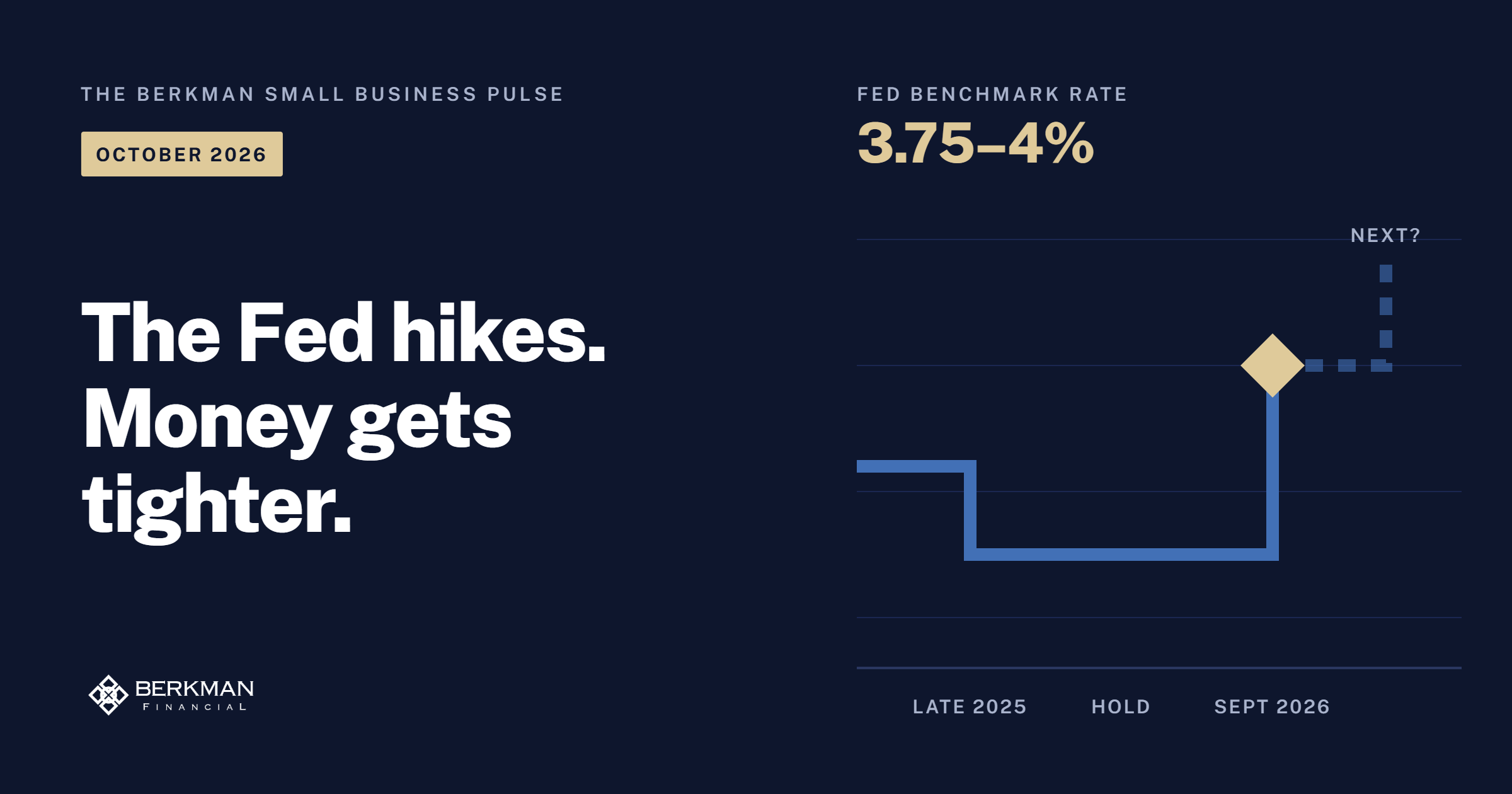
At its September meeting, the Federal Reserve raised its benchmark interest rate by a quarter point to a range of 3.75% to 4%. It's a small number on paper, but a significant turn: this is the first rate increase since 2023, after the Fed spent most of this year holding steady and even cutting late last year.
The vote was unanimous — 12-0 — a sharp contrast to July, when the committee was divided. And the Fed's own projections (the "dot plot") point to the likelihood of another hike before the end of 2026. New Fed Chair Kevin Warsh has been blunt about the priority: getting inflation back to the 2% target, stating plainly that "we have work to do."
What this means for you: the era of waiting for cheaper money is over for now — rates are moving the other direction. Borrowing costs across the economy tend to rise with the Fed's rate, and the signal is that more increases may follow. For a business owner weighing a funding decision, this reinforces a simple point: if you have a real opportunity or need in front of you, waiting for rates to improve is a bet against the Fed's stated direction.
Inflation Watch: Stuck, Not Falling
The reason the Fed is hiking comes down to one stubborn fact: inflation isn't coming down. The most recent reading held at 3.4% annually — unchanged for two straight months and still well above the Fed's 2% target. Core inflation (excluding food and energy) sits at 2.4%.
The bigger pressure is energy. Oil has climbed back to around $100 per barrel, and gasoline prices rose again last month. Energy costs ripple through everything — transportation, materials, and the price of nearly every good that has to be moved — which keeps upward pressure on the broader economy.
What this means for you: if fuel and energy are meaningful costs in your business — trucking, delivery, construction, anything with a fleet or heavy equipment — you're feeling this directly, and it isn't easing. For everyone else, the sticky 3.4% means the day-to-day cost of running your business keeps creeping up while your pricing power may not be keeping pace. This is the squeeze most small business owners are describing right now: costs up, margins pressured, and no relief signal from the top.
The Credit Landscape: Tighter on Every Front
Here's where it all converges. When the Fed raises rates and signals more to come, lenders respond by tightening. Banks get more conservative, approval standards climb, and the cost of the credit that is available goes up. That's the environment small businesses are now operating in — and it's the opposite of loosening.
For small businesses specifically, this is the hardest part of the current cycle. Larger companies have reserves and cheap credit lines to lean on. Smaller operators often don't — which means when banks pull back, the businesses that most need working capital are the ones squeezed hardest.
What this means for you: the traditional lending door is narrowing, not widening. If your business needs capital to navigate this stretch — to cover rising costs, bridge a gap, or move on an opportunity before it passes — waiting for banks to loosen up isn't a strategy that's likely to pay off in this environment. The businesses that navigate tight cycles well are the ones that match the right funding source to their specific need, rather than assuming the bank is the only option.
What's Coming Next
A few things on the near horizon worth watching:
- The next CPI report (October 14): The next major inflation reading. If it stays stuck or rises — especially on energy — it strengthens the case for another rate hike.
- The next Fed meeting (October 27-28): With the dot plot already pointing to another increase, this is the next real test of how aggressive the Fed intends to be.
- Oil prices: The single biggest swing factor. Sustained $100 oil keeps inflation elevated and the Fed in hiking mode; a pullback would ease both.
The practical takeaway: the trend is toward tighter, more expensive credit, not looser. Plan funding decisions around the environment as it actually is, not around a hoped-for reversal.
What This Means for Your Funding Decision
Different situations call for different approaches in a tightening cycle:
If rising costs are squeezing your margins: working capital can bridge the gap between costs that hit now and revenue that arrives later — which matters more, not less, when every input is getting more expensive.
If you've been waiting for rates to drop before making a move: the Fed just told you rates are going up, not down. It may be worth evaluating your opportunity on its own merits rather than waiting for conditions that aren't projected to come.
If your bank has gotten more conservative: you're not imagining it — tightening is happening system-wide. It's worth understanding what options exist beyond traditional bank lending.
The common thread: in a tight-credit environment, knowing your full range of options matters more than ever. That's where working with a broker helps — instead of applying to one lender and hoping, your business gets matched across a network of funders to the option that actually fits your situation.
Frequently Asked Questions
Did the Fed raise interest rates in September 2026?
Yes. The Federal Reserve raised its benchmark rate by a quarter point to a range of 3.75% to 4%, the first increase since 2023. The vote was unanimous at 12-0, and the Fed's projections point to the possibility of another hike before the end of 2026.
What is the current inflation rate in 2026?
The most recent reading held at 3.4% annually, unchanged for two consecutive months and still above the Federal Reserve's 2% target. Core inflation, excluding food and energy, stands at 2.4%. Rising oil and gasoline prices are a key source of ongoing pressure.
Why is the Fed raising rates now?
The Fed is raising rates because inflation has remained stuck above its 2% target and energy costs are climbing, with oil back near $100 per barrel. Fed Chair Kevin Warsh has signaled a firm commitment to bringing inflation down, indicating the central bank is prepared to keep tightening.
How do rising interest rates affect small business funding?
Rising rates generally increase borrowing costs across the economy and lead banks to tighten lending standards, making traditional loans harder to qualify for and more expensive. This often pushes small businesses to explore alternative funding options beyond traditional banks.
Should I wait for interest rates to drop before getting business funding?
The Fed has signaled rates are more likely to rise than fall in the near term, so waiting may mean facing higher costs later, not lower ones. It's generally better to evaluate a funding decision based on the strength of the opportunity or need in front of you rather than on a rate forecast.
How can small businesses get capital when banks are tightening?
Beyond traditional bank loans, options include lines of credit, revenue-based funding, invoice financing, and short-term working capital funding — many of which weigh business performance more heavily than a tight bank would. A broker can match your situation across multiple funders to find the best available fit.
The Bottom Line
October's story is straightforward: the Fed is tightening, inflation is stuck, energy costs are rising, and credit is getting harder and more expensive to come by. For small business owners, that means the smart move is to plan around the environment as it is — not to wait for a reversal the Fed has signaled isn't coming. Where you need capital to navigate the squeeze, knowing your full range of options is more valuable than ever.
If your business could use working capital to get through this stretch — to cover rising costs, bridge a gap, or seize an opportunity before it passes — it's worth understanding what's available to you.
The Berkman Small Business Pulse is published monthly by Berkman Financial. Data reflects the most recent available figures from the Federal Reserve and U.S. Bureau of Labor Statistics as of publication. This briefing is educational and not financial advice. Berkman Financial is a financing broker that works across a network of funders; we do not guarantee approval, rates, or specific funding outcomes.