TL;DR — What Matters This Month
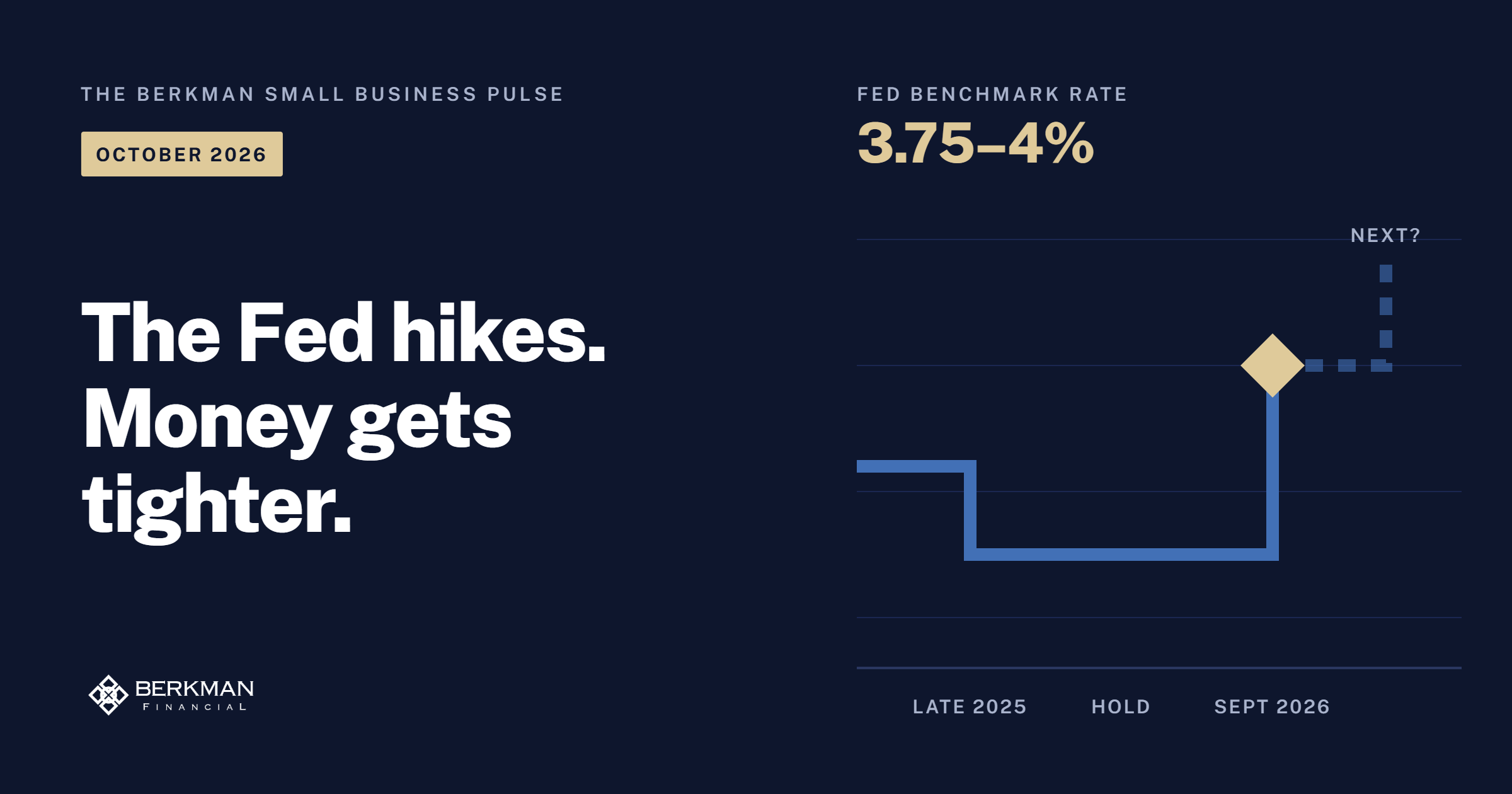
- Fed funds rate: Held at 3.50%–3.75% at the June meeting under new Chair Kevin Warsh — the fifth hold in a row
- Next FOMC decision: July 28–29, 2026 — markets currently priced at 62.6% chance of another hold, 37.4% chance of a 25-basis-point hike
- Prime rate: 6.75% (unchanged since March)
- Inflation (CPI): 4.2% year-over-year in May — the highest in three years, driven mostly by energy price spikes tied to the Iran conflict
- The signal for small businesses: Traditional bank lending is tightening. Approval rates at large banks are running just 13–15%. Alternative funding demand is climbing fast.
The Fed and where interest rates actually stand
New Fed Chair Kevin Warsh presided over his first FOMC meeting in June 2026 — and the takeaway wasn't the rate decision. It was the tone.
The committee unanimously voted to hold the federal funds rate at 3.50%–3.75%, but Warsh dropped previous language that had hinted at a bias toward future cuts. The updated dot plot removed the anticipated 2026 rate cut entirely and pushed any reductions into 2027 or 2028. The median projection for year-end 2026 is now 3.8% — suggesting at least one rate hike is on the table before December.
What this actually means for your business:
Prime rate — the number that drives SBA loans, business lines of credit, and traditional bank pricing — currently sits at 6.75%. If the Fed does hike in July or later this year, expect prime to move to 7.00% within days of the decision.
For a small business owner considering funding, that translates to:
- SBA 7(a) variable-rate loans currently running 9.75% to 13.25% could climb to 10.00% to 13.50% range post-hike
- Business lines of credit currently in the 8% to 22% APR range would see the low end shift to 8.25%+
- Bank term loans at 6.80% to 11.00% would step up accordingly
The best move for merchants right now: if you know you need funding in Q3 or Q4, locking in today's rates before a potential hike could save real money over the loan's life.
Inflation, energy prices, and what's really driving costs
May 2026's Consumer Price Index came in at 4.2% year-over-year — the fastest pace of inflation in three years. But the details matter more than the headline number.
Energy costs jumped 23.5% year-over-year, driven by the ongoing conflict affecting Middle East oil supplies. Core PCE inflation — which strips out volatile energy and food prices — held at a more manageable 3.3%, still above the Fed's 2% target but not spiraling.
The recently-announced preliminary peace framework between the U.S. and Iran is starting to ease some of that pressure. Global oil prices dropped sharply on the announcement. If sustained, that could mean:
- Freight and delivery costs stabilize by Q4
- Utility bills for storefront businesses (restaurants, retail, salons) come off recent highs
- Trucking margins improve as diesel costs moderate
For small business owners specifically, this matters because energy costs have been the invisible tax hitting margins. If oil pulls back and the Fed doesn't feel forced to hike further, we could see the best window for stable business planning we've had in two years.
The small business lending landscape right now
Here's where the numbers tell the real story of what's happening in small business credit.
According to the Federal Reserve's 2026 Small Business Credit Survey and current market data:
Approval rates by lender type:
| Lender type | Approval rate |
|---|---|
| Large banks | 13–15% |
| Community banks | 19–22% |
| Credit unions | 20–24% |
| Online lenders | 26–30% |
| Small banks (best outcomes overall) | 57% fully approved |
Cost transparency by lender type:
| Lender type | % reporting costs higher than expected |
|---|---|
| Online lender borrowers | 60% |
| Small bank borrowers | 37% |
| Large bank borrowers | 32% |
What this tells us:
The traditional bank lending market — for merchants who need $250K to $2M — is running the tightest it's been in three years. Large banks are rejecting 85% of applications. Even highly qualified businesses are hitting walls that weren't there in 2023.
Meanwhile, online lenders have loosened qualification but at costs that surprise a majority of borrowers after the fact. Merchants who go straight to online lenders without shopping are consistently overpaying.
This is exactly why working through an experienced business loan broker matters more in 2026 than it did in 2023. The right funder for a given merchant is increasingly specific — the wrong match now can mean 30–40% more in total cost than the right one.
Sector watch — what's happening by industry
Different industries are seeing different pressures. Here's what our funder network is reporting across the sectors we work with most:
Restaurants & food service: Traffic normalized after the post-holiday pullback, but food costs remain 8–12% above 2024 levels. Restaurants are heavily indexed to alternative funding right now — SBA approval is slow, and cash flow gaps hit weekly. Merchant cash advances remain the most popular product for restaurant working capital because repayment flexes with daily card sales.
Trucking & logistics: Owner-operators are getting squeezed on diesel prices but benefiting from freight demand as tariff-adjustment logistics continue reshaping supply chains. Equipment financing has stayed active. MCA demand for working capital during load-payment delays is elevated.
Construction: A mixed picture — commercial construction is slowing on interest-rate sensitivity, but residential remodel and repair work stays strong. Construction businesses that fund equipment purchases now (before any Fed hike) are locking in the best structures we've seen this quarter.
Retail (independent): Struggling with margin compression as consumer discretionary spending softens. Working capital demand is high — retailers are borrowing to bridge slower months rather than for growth.
Medical & dental practices: Steady demand for practice expansion funding. These businesses often qualify for SBA products but face 90-day approval timelines that don't match acquisition or equipment purchase deadlines — bridge funding has been a common structure.
What this means for your funding decision right now
Pulling all of this together, here's how we'd frame the funding decision if you own a small business in July 2026:
If you know you need capital in the next 90 days: Don't wait. The Fed's July 28–29 meeting could push rates higher. Even if it doesn't, the dot plot suggests a hike is likely before year-end. Locking in today's pricing on any variable-rate product could save real money.
If your business needs $10K–$100K for working capital or short-term cash flow: Traditional bank timelines (30–90 days for SBA, 2–4 weeks for term loans) won't match your urgency. Merchant cash advances and lines of credit through alternative funders are typically the fastest path — but shop it. Going direct to the first online lender is where merchants overpay 30%+ regularly.
If your business needs $250K–$2M for expansion, equipment, or growth: This is where an experienced broker adds the most value. The right funder for your specific business profile has become more specialized in 2026 — the wrong match can cost you tens of thousands. Berkman's funder network shops your file across multiple options simultaneously to find the actual best fit for your situation. See the full range of capital products available.
If you're a newer business (under 2 years) or working with challenged credit: Traditional bank approval rates make direct applications a low-probability move. Alternative funders remain the path most similar businesses successfully take — but qualification varies significantly by funder, and structure matters more than the rate alone.
Common questions about small business lending in July 2026
Will the Fed raise rates at the July 2026 meeting?
Markets currently price a 62.6% probability that the Fed holds and 37.4% probability of a 25-basis-point hike at the July 28–29 meeting. The updated dot plot suggests at least one hike is likely before year-end, but the exact timing depends on inflation data between now and then.
How does the Fed rate affect small business loan pricing?
The Fed funds rate directly influences the prime rate, which is what most bank loans and SBA loans are priced from. When the Fed hikes 25 basis points, prime typically moves in lockstep within days. For a small business owner, that means variable-rate products (lines of credit, most SBA 7(a) loans) reprice immediately, while fixed-rate loans lock in at the rate you had when you closed.
Is now a good time to apply for a business loan?
If you know you need funding within the next 3–6 months, applying now is probably smarter than waiting. The likelihood of rates being lower in Q4 is low. The likelihood of rates being the same or higher is meaningfully greater. That said, don't apply out of fear — apply because you have a specific use case for the capital.
What credit score do I need for a small business loan in 2026?
It varies dramatically by lender type. Large banks typically want 700+ FICO. SBA loans generally need 680+. Community banks work with 660+. Online lenders can approve as low as 550–580. Alternative funders (including MCAs) may work with scores as low as 500 depending on business performance.
How is inflation affecting my business's funding options?
Higher inflation is one reason the Fed is holding rates high. That's making traditional bank credit more expensive AND harder to get approved for. Alternative funding demand is up as a result. If your business's own costs are inflated (energy, food, labor), lenders will factor that into your cash flow evaluation — strong documentation of consistent revenue matters more in 2026 than it did in 2023.
How can Berkman help me navigate the current lending environment?
Berkman Financial operates as an ISO with a direct funder network of multiple lending partners. When you apply through us, we don't just send you to one option — we shop your file across our network to find the best fit for your specific situation, credit profile, and use of funds. In an environment where the wrong match costs meaningfully more than it did two years ago, that shopping process has real dollar value. Learn more about how working with a broker works.
Final word
The July 2026 lending environment is more nuanced than any month in the past 24. Rates are elevated but stable. Inflation is high but potentially peaking. Bank credit is tight, but alternative funding is available if you know where to look.
The best move for most small business owners right now: know your options before you need them. Understand what your credit profile qualifies you for. Have a relationship with a funding advisor already in place so that when opportunity or emergency hits, you're not scrambling.
If you're weighing a funding decision — or just want a read on what your business would qualify for in today's market — Berkman's advisors are ready to talk it through with you. No hard credit pull to check, no pressure, just an honest read on your options.
See what your business qualifies for
This is the first edition of the Berkman Small Business Pulse — our monthly briefing on interest rates, credit conditions, and what's happening in small business funding. Watch for the August 2026 edition the first week of next month.