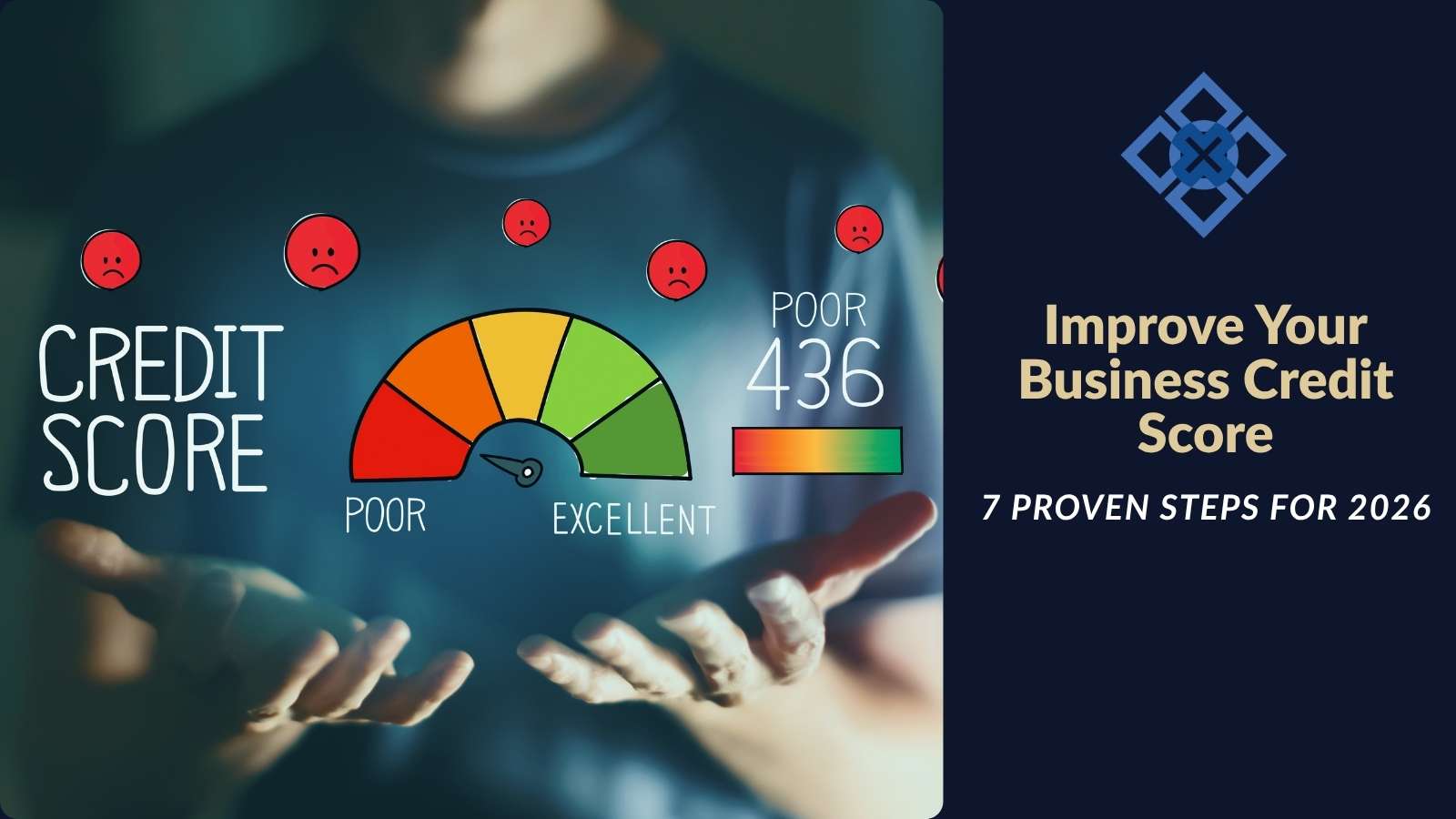
Your business credit score can be the difference between getting funded at a good rate and getting turned down entirely. But most small business owners don't even know they HAVE a business credit score — separate from their personal one — much less how to improve it.
Business credit is built differently than personal credit. Different reporting agencies, different scoring models, different factors. And once you know how it works, you can build it faster than you might think.
This guide covers what business credit is, how it's scored, and 7 practical steps to improve yours in 2026.
TL;DR: Business credit scores range from 0 to 100 (Dun & Bradstreet and Experian) or 101 to 992 (Equifax) and are tracked separately from your personal score. They are built by paying suppliers and vendors on time, opening trade credit accounts, and maintaining good financial standing with the three major business credit bureaus. You can meaningfully improve your business credit score in 3 to 6 months with consistent effort. Even if your business credit is not strong, alternative funding options are available — Berkman Financial's funder network underwrites based on revenue, not just credit scores.
What is a business credit score (and how is it different from personal credit)?
A business credit score measures how creditworthy your business is — independent of your personal credit profile. It is used by lenders, suppliers, landlords, and insurers to evaluate the financial risk of doing business with your company.
The key differences between business and personal credit:
| Feature | Business Credit | Personal Credit |
|---|---|---|
| Score range | 0–100 (D&B, Experian) or 101–992 (Equifax) | 300–850 (FICO) |
| Who can view it | Anyone — business credit reports are public | Only with your permission |
| What it tracks | How you pay suppliers, vendors, and creditors as a business | How you pay personal debts |
| How it's built | Trade credit, vendor accounts, business loans | Credit cards, mortgages, personal loans |
| How fast it changes | Can improve significantly in 3–6 months | Takes 6–12+ months to move materially |
The biggest surprise for most business owners: your business credit is public. Anyone can pull your business credit report without your consent. This means potential partners, landlords, and large customers may check your business credit before working with you.
The 3 main business credit reporting agencies
Three agencies track and score business credit. Each uses its own scoring model:
Dun & Bradstreet (D&B) — PAYDEX Score
- Range: 0 to 100
- Based entirely on your payment history with vendors and suppliers who report to D&B
- A score of 80+ is considered good — it means you pay on time or early
- Requires a D-U-N-S number (free to obtain)
Experian Business — Intelliscore Plus
- Range: 0 to 100
- Factors in payment history, credit utilization, public records (liens, judgments, bankruptcies), and company age
- A score of 76+ is considered low risk
Equifax Business — Business Credit Risk Score
- Range: 101 to 992
- Considers payment history, credit utilization, company size, industry risk, and public filings
- Higher scores indicate lower risk
Not all vendors and lenders report to all three bureaus. To build the strongest business credit profile, you want activity reporting to at least D&B and Experian.
What affects your business credit score
The factors that move your business credit score, roughly in order of importance:
- Payment history — the single biggest factor. Paying vendors, suppliers, and creditors on time (or early) is the fastest way to build score. Late payments — even by a few days — hurt significantly.
- Credit utilization — how much of your available credit you are using. Lower utilization (under 30%) signals financial health.
- Time in business — longer operating history generally means a higher score. Nothing you can do about this except stay in business.
- Number of trade references — more active vendor accounts reporting positive payment history strengthens your profile.
- Public records — liens, judgments, collections, and bankruptcies damage your business credit severely.
- Industry risk — some industries are scored more conservatively than others. You cannot control this, but you can offset it with strong payment history.
7 steps to improve your business credit score
Step 1: Get your D-U-N-S number
If you do not already have a D-U-N-S number, get one. It is free from Dun & Bradstreet and is the foundation of your D&B credit profile. Without it, D&B cannot build a file on your business, and your PAYDEX score will not exist.
Go to Dun & Bradstreet's website, search for your business, and request a D-U-N-S number if one has not been assigned. It takes about 30 days to process through the free channel.
Step 2: Open trade credit accounts with vendors who report
Not all vendors report your payment activity to business credit bureaus. Seek out vendors and suppliers who do. Common options include office supply companies, shipping companies, fuel card providers, and business-to-business net terms accounts.
Ask before opening an account: "Do you report payment history to Dun & Bradstreet, Experian, or Equifax?" If they do, open the account and use it regularly.
Step 3: Pay every bill early — not just on time
For your PAYDEX score specifically, paying early scores higher than paying on time. A PAYDEX of 80 means you pay on time. A PAYDEX of 100 means you pay early. If you can pay vendor invoices a few days before the due date, do it. This is the single fastest lever you have.
Step 4: Separate business and personal finances completely
Open a dedicated business bank account and business credit card. Route all business expenses through business accounts. This separation ensures that your business activity builds business credit (not just personal credit) and keeps your records clean for funders and bureaus.
Step 5: Monitor your business credit reports
Pull your business credit reports from all three bureaus at least quarterly. Look for errors — incorrect balances, misattributed accounts, or outdated information. Disputes can be filed directly with each bureau.
D&B offers a free basic report. Experian and Equifax business reports are available through their paid platforms or through third-party monitoring services.
Step 6: Keep credit utilization low
If you have a business credit card or line of credit, keep your outstanding balance below 30% of the available limit. High utilization signals to scoring models that your business may be financially stretched.
This means: if you have a $50,000 line of credit, try to keep your outstanding balance under $15,000. Pay down balances before statement closing dates for the best impact.
Step 7: Address negative items directly
If you have late payments, collections, liens, or judgments on your business credit report, address them. Pay outstanding balances, negotiate payment plans for collections, and resolve liens. While negative items do not disappear immediately, resolving them stops the ongoing damage and begins the recovery process.
For tax liens specifically, work with a CPA or tax advisor. Unresolved federal or state tax liens are among the most damaging items on a business credit report.
How long does it take to build good business credit?
Faster than you might expect, if you are intentional:
- 0 to 30 days: Get your D-U-N-S number, open two to three trade credit accounts, separate finances
- 30 to 90 days: Begin building payment history. PAYDEX scores can appear within 60 to 90 days of your first reported trade payments.
- 3 to 6 months: With consistent on-time (or early) payments to three or more reporting vendors, you should see a meaningful PAYDEX score in the 70 to 80+ range.
- 6 to 12 months: Your profile deepens. More trade references, longer payment history, and lower utilization all compound to strengthen your score across all three bureaus.
Business credit builds faster than personal credit because the scoring models weight recent payment behavior heavily. A business with no history can reach a strong PAYDEX within six months by paying a handful of reporting vendors early and consistently.
Common mistakes that hurt your business credit
- Not separating personal and business finances — if all expenses run through personal accounts, no business credit history is built
- Not checking for a D-U-N-S number — without it, D&B has no file on your business
- Paying on the due date instead of early — on time is good, but early scores higher on PAYDEX
- Ignoring vendor selection — if your vendors do not report to credit bureaus, your payment history is invisible
- Maxing out business credit cards — high utilization hurts business credit just like personal credit
- Letting small debts go to collections — even a $200 unpaid invoice that goes to collections can damage your score significantly
- Not monitoring reports — errors on business credit reports are common and go unnoticed unless you check
How business credit affects your funding options
Your business credit score directly impacts what funding products are available to you and at what cost:
Strong business credit (PAYDEX 80+, Experian 76+):
- Qualifies for bank term loans, SBA loans, and premium lines of credit
- Lowest interest rates and longest terms
- Best negotiating position with funders
Moderate business credit (PAYDEX 50–79, Experian 50–75):
- Alternative funding products (lines of credit, revenue-based funding) available at competitive rates
- Bank products may require collateral or higher rates
- Room for improvement, but fundable
Low or no business credit (PAYDEX under 50 or no score):
- Traditional bank products unlikely without collateral or a personal guarantee
- Merchant cash advances and revenue-based funding remain accessible — these products underwrite on revenue, not credit
- Building business credit while using alternative funding creates a path to better products over time
Even with no business credit score, you can access capital. Berkman Financial's funder network underwrites primarily on monthly revenue and business performance. We have funded over $525 million across 10,000+ businesses — many with limited or no business credit history.
See what you qualify for today
The point is not that you need perfect business credit to get funded. The point is that building it gives you more options, better rates, and stronger leverage in every future funding conversation. And it starts with seven straightforward steps you can begin today.
Common questions about business credit scores
What's considered a good business credit score?
A PAYDEX score of 80 or higher (Dun & Bradstreet) and an Intelliscore of 76 or higher (Experian) are considered good. These scores indicate that you pay on time or early and present low risk to funders and suppliers. A PAYDEX of 100 is the highest possible score and indicates early payment on all trade accounts.
How long does it take to build business credit?
You can establish a visible business credit profile in 60 to 90 days and build a strong PAYDEX score (80+) within three to six months. This requires opening trade credit accounts with vendors who report to the bureaus and paying early consistently. Business credit builds faster than personal credit because scoring models emphasize recent payment behavior.
Can I get business funding without a good business credit score?
Yes. Many alternative funding products — including merchant cash advances, revenue-based funding, and some lines of credit — are underwritten based on your business revenue and bank statements, not your credit score. Berkman Financial's funder network approves businesses with credit scores as low as 500. Strong revenue can offset weak credit.
Does personal credit affect my business credit score?
Not directly — they are separate scores tracked by different bureaus using different data. However, some business credit scoring models (like Experian's Intelliscore) do factor in the owner's personal credit as one input. And many funders check both scores during underwriting. Building both simultaneously is the best strategy.
How do I check my business credit score?
Dun & Bradstreet offers a free basic report through their website (search your D-U-N-S number). Experian and Equifax business reports are available through their paid platforms or through third-party monitoring services like Nav, CreditSignal, or Credit.net. Check all three bureaus at least quarterly.
What business credit score do I need for a merchant cash advance?
Most MCA providers do not have a minimum business credit score requirement. MCAs are underwritten primarily on your monthly revenue and bank account activity. Personal credit scores as low as 500 are accepted, and business credit scores are often not checked at all. This makes MCAs one of the most accessible capital products for businesses with limited credit history.