2026 Update — Key Numbers Right Now
- CPI: 4.2% year-over-year (May 2026) — the highest in three years
- Energy costs: +23.5% year-over-year, driven by Middle East supply disruptions
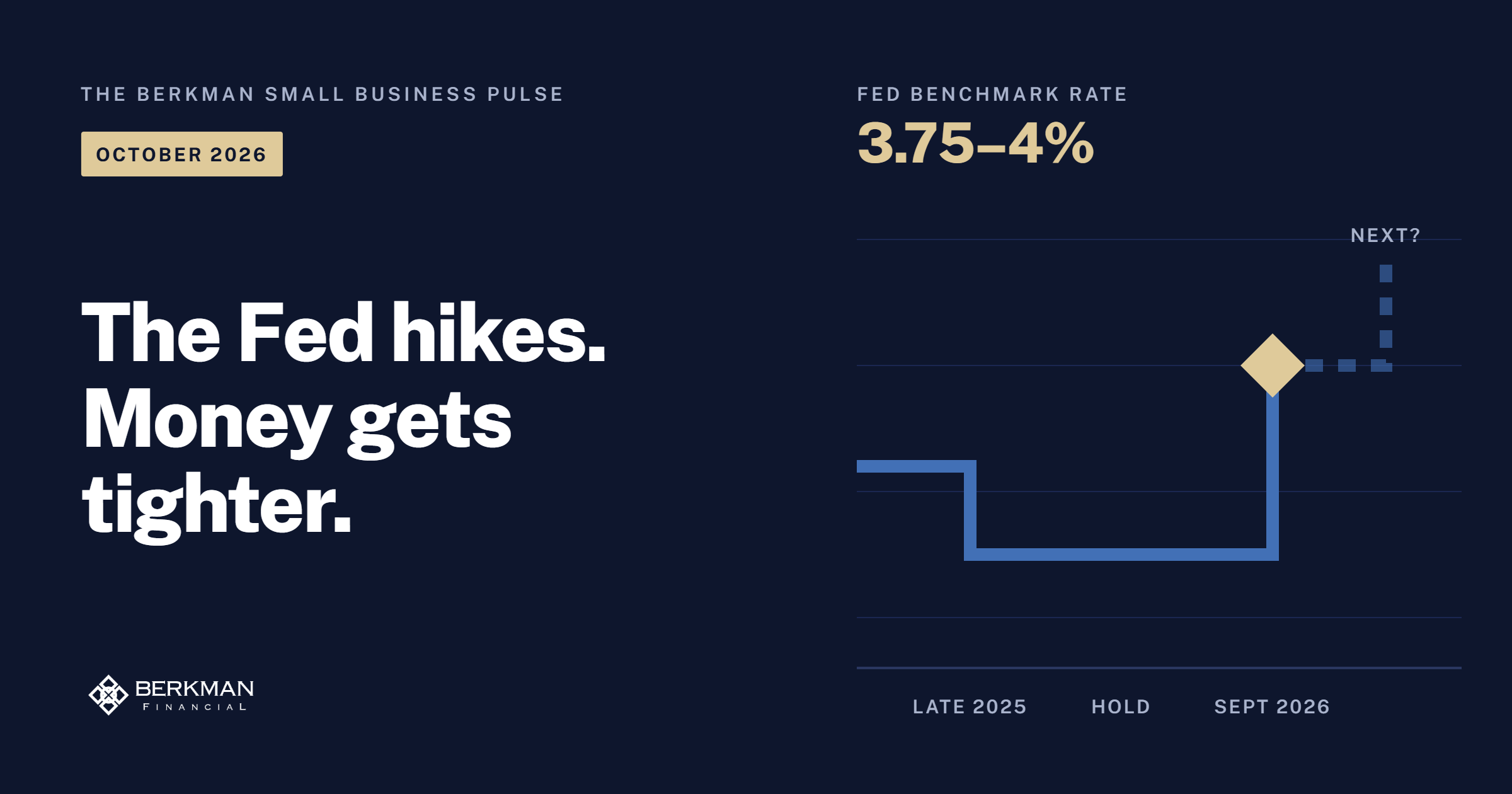
- Fed funds rate: 3.50%–3.75% (held steady, but a hike is possible before year-end)
- Prime rate: 6.75% — directly affects SBA loans, lines of credit, and bank pricing
- Large bank approval rates: 13–15% — the tightest in three years
For the full monthly breakdown, read The Berkman Small Business Pulse — July 2026.
Inflation's real impact on small businesses in 2026
Inflation is not just about higher prices at the gas pump or grocery store. For small business owners, it is a compounding force that quietly erodes margins, delays growth, and forces difficult decisions every month.
The May 2026 Consumer Price Index hit 4.2% year-over-year — the fastest inflation rate in three years. But the headline number does not tell the full story. Energy costs surged 23.5%, food costs remain 8–12% above 2024 levels, and commercial rents in major metro areas have climbed 6–9% over the past 12 months. For a small business operating on 5–10% net margins, those increases can wipe out profitability entirely.
Understanding where inflation hits hardest — and what you can do about it — is essential for surviving and growing through this cycle.
Rising operational costs: where the money is going
Inflation does not affect every cost equally. Here is where small businesses are feeling the squeeze most in 2026:
Energy and utilities: The 23.5% year-over-year increase in energy costs is the single biggest pain point. Restaurants paying $3,000/month for gas and electric are now paying $3,700+. Trucking companies are absorbing diesel prices that have fluctuated between $4.20 and $5.10 per gallon. Retail stores and salons running HVAC systems 12 hours a day are seeing utility bills 20–30% higher than two years ago.
Rent and occupancy costs: Commercial lease renewals in 2026 are coming in 6–9% higher in most markets. A restaurant paying $8,000/month that renews at a 7% increase adds $6,720 per year in fixed costs — with no corresponding increase in revenue.
Labor costs: The tight labor market continues to push wages higher. Average hourly earnings for production and nonsupervisory workers rose 4.1% year-over-year as of Q1 2026. For a business with $30,000/month in payroll, that is an additional $1,230/month just to retain existing staff.
Supplies and raw materials: Food costs for restaurants remain 8–12% above 2024 levels. Construction materials — lumber, steel, concrete — have stabilized somewhat but remain 15–20% above pre-2022 prices. Retail inventory costs have risen with tariff adjustments reshaping supply chains.
Insurance: Commercial insurance premiums climbed 8–12% in 2025–2026, with property and casualty coverage seeing the steepest increases. For many small businesses, annual premiums now represent a five-figure fixed cost that arrives in a lump sum.
The strain on business growth
When every dollar goes further just to maintain operations, growth gets sidelined. This is the hidden cost of inflation that does not show up on any single line item but defines the trajectory of thousands of small businesses.
Expansion plans get delayed. Marketing budgets get cut. Equipment upgrades get postponed. Hiring gets frozen. The business survives, but it stops moving forward — and competitors who are better capitalized take market share.
According to the Federal Reserve's 2026 Small Business Credit Survey, 42% of small businesses reported that rising costs were their single biggest challenge — ahead of finding customers, hiring, and access to credit. The businesses that are navigating this environment successfully are the ones that have planned ahead, locked in funding before they needed it, and maintained flexibility in how they deploy capital.
What small businesses should do right now
Surviving inflation is not about one big move. It is about a series of practical adjustments that protect your margins and keep your options open.
1. Audit your costs quarterly, not annually. Inflation moves fast enough that annual reviews miss critical changes. Review your top 10 expense categories every 90 days. Look for costs that have crept up without a corresponding increase in value — subscriptions, vendor contracts, insurance, and utility plans.
2. Renegotiate vendor terms before renewals hit. Vendors are feeling the same pressures you are, but many will negotiate rather than lose a reliable customer. Ask for extended payment terms (NET 30 → NET 45), volume discounts, or price locks on key inputs. Every dollar saved in cost of goods goes straight to your margin.
3. Price strategically, not reactively. Many small business owners resist raising prices out of fear of losing customers. But absorbing 100% of cost increases is not sustainable. A 3–5% price adjustment, positioned transparently ("due to rising costs"), retains most customers while protecting your margin. Test it on your highest-margin offerings first.
4. Build a capital reserve before you need it. The worst time to seek funding is when you are already in a cash flow crisis. A business line of credit opened now — even if you do not draw on it immediately — gives you a safety net that costs nothing until you use it. If you wait until you are in trouble, approval becomes harder and terms become worse.
5. Lock in funding at today's rates. The Fed's July 28–29 meeting could result in a rate hike that pushes prime from 6.75% to 7.00%. If you know you need capital in the next 3–6 months, applying now locks in current pricing before any increase. See what your business qualifies for.
How to fund through an inflationary period
Inflation changes the funding calculus for small businesses. Traditional bank lending has tightened — large banks are approving just 13–15% of applications, the lowest rate in three years. But alternative funding remains accessible, and the right product can be the difference between surviving inflation and growing through it.
For ongoing cash flow gaps: A business line of credit lets you draw capital when you need it and pay interest only on what you use. This is the most cost-effective tool for managing the month-to-month variability that inflation creates.
For immediate working capital needs: A merchant cash advance provides same-day funding with repayment tied to your daily sales. When your costs spike unexpectedly — an equipment breakdown, an insurance premium due, a payroll gap — an MCA fills the gap without the 30–90 day wait that bank products require.
For larger growth investments: If you are investing $100K+ in expansion, equipment, or inventory despite inflationary pressures, compare products across our funding options. The right structure — term length, repayment model, total cost — matters more in a high-rate environment than it does when rates are low.
For businesses unsure which product fits: Working with a business loan broker gives you access to multiple funders through a single application. In an environment where the gap between the best and worst offers has widened, shopping your file across a funder network has real dollar value.
The businesses that are thriving through 2026's inflationary environment are not the ones ignoring costs — they are the ones who planned ahead, secured flexible capital, and made strategic adjustments before they were forced to.
Common questions about inflation and small businesses
How is inflation affecting small businesses in 2026?
Inflation at 4.2% year-over-year is compressing margins across nearly every industry. Energy costs are up 23.5%, commercial rents are up 6–9%, labor costs are up 4.1%, and supply costs remain elevated. For small businesses operating on 5–10% net margins, these increases can eliminate profitability without strategic adjustments to pricing, cost management, and capital planning.
What operational costs are rising the fastest?
Energy and utilities lead at 23.5% year-over-year, followed by commercial insurance (8–12% increases), labor (4.1% wage growth), and commercial rent (6–9% on renewals). Food costs for restaurants remain 8–12% above 2024 levels. These increases are not uniform — some industries are hit harder than others, with restaurants, trucking, and retail feeling the most pressure.
Should I take on business debt during inflation?
It depends on the purpose. Taking on debt to cover operating losses without a plan is risky. Taking on debt to invest in revenue-generating activities — inventory, marketing, equipment, expansion — can make sense if the return exceeds the cost of capital. The key question: will this capital generate enough revenue to cover its cost plus a margin? If yes, inflation actually makes waiting more expensive, since rates may rise further.
How can I protect my cash flow from inflation?
Start with quarterly cost audits, vendor renegotiations, and strategic price adjustments. Build a capital reserve — a line of credit that you can draw on before cash flow tightens. Lock in any needed funding at today's rates before potential Fed hikes. And monitor your margins monthly, not quarterly — inflation moves faster than most small business owners track.
What funding options work best during inflationary periods?
Lines of credit provide the most flexibility — you pay interest only on what you draw. Merchant cash advances provide speed when you need emergency capital. Revenue-based funding flexes with your sales volume. The right choice depends on your situation, timeline, and what the capital is for. Compare all options on our funding products page, or apply in 5 minutes to see what you qualify for today.
Take control of your inflation strategy
Inflation is not going away in 2026 — but the businesses that plan ahead, secure flexible capital, and make smart adjustments will come out the other side stronger. The worst response to inflation is paralysis. The best response is action.
Berkman Financial has funded over $525 million across 10,000+ businesses since 2015 — through low-rate environments, high-rate environments, and everything in between. If you are weighing a funding decision or want an honest assessment of your options in today's market, our advisors are here to help.
No hard credit pull. No pressure. Just a real conversation about what makes sense for your business right now.
See what your business qualifies for